US and Worldwide
Fall 2019
Irregularity, asymmetry and imperfection were important elements in traditional Japanese aesthetic philosophy. The aesthetic and conceptual meaning of the ‘rips’ in Kawakubo’s sweater differs significantly from the political and satiric meaning of the ripped and over-sized ‘poor look’ that simultaneously emerged as an element of London street style, which Vivienne Westwood made famous. Japanese designers like Kawakubo and Yohji Yamamoto were drawing on an entirely different tradition when they experimented with cutting asymmetrically so that, say, one side of a jacket would be longer or wider than the other.
The new Japanese clothes also tended to be oversized and loose; to a hostile viewer, big and bulky. For several years, the Japanese conception of the relationship between body and clothes puzzled and annoyed many westerners; French designer Sonia Rykiel speculated that the Japanese must be ‘afraid of the body.’ In fact, they had a very different conception of sexiness. As Kawakubo told Vogue, ‘I do not find clothes that reveal the body attractive.’
By the end of the decade many people would have agreed with Vogue’s Charlotte DuCann, that avant-garde Japanese fashion was ‘the supreme modern style, the style that yanked fashion from its seventies nostalgia right into the monochrome eighties. No other country has single-handedly caused quite so much outrage and adulation in such a short time as Japan.’ Within half a decade the Japanese had succeeded in radically revising contemporary perceptions of fit and proportion, and in inaugurating the reign of black.
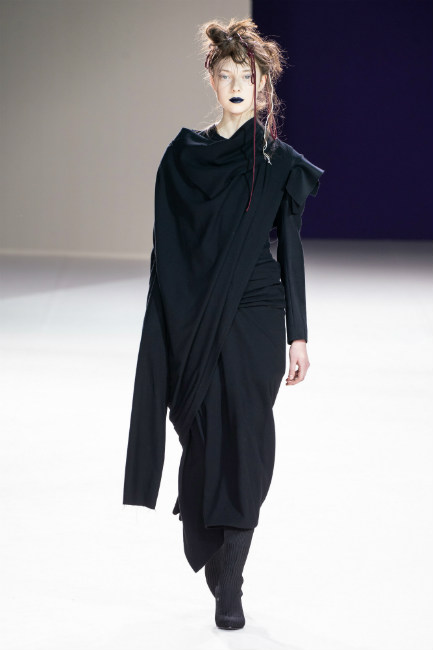
Yohji Yamamoto, Fall 2019
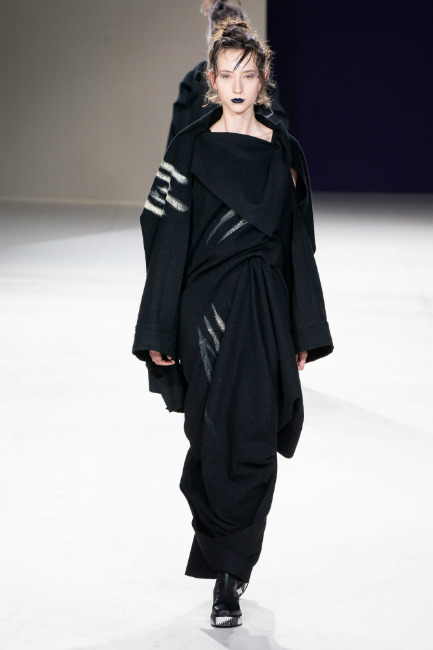
Yohji Yamamoto, Fall 2019
Black became the quintessential ‘anti-fashion’ color in the 1980s; Kawakubo, especially, was said to work in a dozen shades of black, but black was soon adopted by other designers around the world for a variety of reasons. Crucially important was the association of black clothing with an artistic and intellectual persona.
Earlier ideas about bohemian black and rebellious black were particularly influential, and looked back to 1950s beatniks and bikers. Black was once again ‘hip’ and ‘cool.’ ‘It’s a very peculiar sensitivity that artists seem to have about black,’ declared Rags as early as 1970. ‘Black just doesn’t pick up vibes and doesn’t send out any; it’s very protective.’ Within a few years, purple tie-dyed velvets would be traded in for studded black leather.
The popularity of black in the 1980s was overdetermined. The Japanese made the color avant garde again. They, in turn, were followed by young European designers like the Belgian Anne Demeulemeister, whose use of black evoked the ‘decadent’ poets of the nineteenth century. (In 1990 she was quoted as saying that she could not imagine a poet in any color other than black.)
Y-3 spring 2021 menswear
Adidas’s Nic Galway has been working on the company’s Y-3 collections since their inception 20 years ago. In those two decades, he has developed a symbiotic relationship with Yohji Yamamoto—one of fashion’s most influential, but elusive designers. “We have done our fittings for close to 20 years in the same room in Tokyo with the same sofa and the same people,” Galway says over a video call. “To do it over Zoom and see the same room, but not be there is strange, but…” he trails off. In a way Galway and Yamamoto have perfected the art of remote work, communicating often from their bases in Tokyo and Berlin. Still, there is a world of difference between being in the atelier watching the master drape in-person and trying to understand his vibrations over an online chat.
The strength of their relationship helped guarantee that the spring 2021 Y-3 collection would be as good as any. Not changing too much is also the Yamamoto way, which of course helps. “We’ve been on an amazing journey and I’ve always loved how true Yohji is to his principles,” Galway continues. Those principles are tailoring and fit, as well as a deep connectivity to the way his clothing moves through real life.

Y-3 spring 2021 menswear

Y-3 spring 2021 menswear
Presciently, the idea Yamamoto wanted to focus on for spring 2021 was protection from the natural elements. (This idea was conceived long before COVID-19 made that a global worry.) The collection divides into three parts, each inspired by the change of seasons in Japan: The first responds to Tsuyu, the rainy season, with garments that cover the entire body in Gore-Tex and covered seams. The second takes on haru-ichiban, the first winds of spring, with windbreakers and wind-repellent materials, and the last meditates on the idea of kage wo otosu—casting shadows—to offer protection from the sun. The key elements that run throughout are hoods, hats, anoraks, and techy materials to create a protective layer between the wearer and the world. Most salient for a modern audience are the hoodies with a face covering that snaps across the front.
Longtime Y-3 acolytes will appreciate the recurring black, ivory, and red palette—Yohji signatures. But there are also touches of lilac, navy, and a graphic floral motif. The idea for these softer colors was “to bring newness but not disrupt too much,” Galway says. When you have been conveniently ahead of the game for two decades—predicting luxury performance wear, infusing technical clothing with a fashionable sensibility, and steering a global collaboration—not changing is the ultimate symbol of success.